
Appearance
How the Math Works
Ordara stores two things: which order lines belong to which product, and a dated log of your sales and adjustments. Every summary figure (ordered, delivered, on hand, sold, revenue, cost per unit, profit) is derived from those and recomputed on the fly. None is editable directly. You change a figure by changing the entries underneath; to correct a sale or adjustment, delete it and record it again.
Two values are captured onto a transaction and then left alone:
- the fee in dollars, frozen the moment you save a sale;
- the unit cost, frozen as soon as Ordara has a complete cost to freeze (usually the same moment).
Both exist so that editing a fee preset or restocking at a new price cannot rewrite profit you have already reviewed. Any figure you disagree with traces back to the orders, sales and adjustments behind it.
Your order data is never edited
Corrections such as a cost override are recorded alongside the parsed order, so the email-derived record stays intact and re-syncing is always safe.
The quantity metrics
| Metric | How it is calculated |
|---|---|
| Ordered | Every unit on the order lines linked to this product, less cancelled units |
| Delivered | The units those orders have delivered (see below) |
| Sold | Every unit across the sales you have recorded |
| Adjustments | The running total of your quantity corrections, positive and negative |
| On hand | Delivered − Sold + Adjustments |
| Unsold | Ordered − Sold |
On hand is what you physically have now. Unsold is what you have not sold yet, arrived or not. They differ when some of what you ordered has not been delivered, or when adjustments changed what is on the shelf.
Lines waiting in Needs review are not counted in any of these until you resolve them.
Cancelled units drop out
Cancellation is counted per unit. A whole-order cancellation removes all of that order's lines; a line-level cancellation (the retailer cancels one item and ships the rest) removes only the cancelled units. The product's Ordered, Delivered and cost figures drop when the cancellation lands. The Orders tab shows the split as "N kept" over "M cancelled". See Accuracy & Limitations.
How "Delivered" is determined
For each linked order line, Ordara takes the greater of:
- the quantity marked delivered on that line's shipments, and
- the line's full quantity, if the whole order is marked delivered (by the retailer, or by you with Mark as delivered or Mark Collected; see Orders).
Many retailers announce delivery for the whole order without itemizing it; without rule 2 those lines would read as zero delivered.
The result is capped at the line's quantity after cancellations, so a line covered by more than one shipment email can never report more units delivered than it has.
WARNING
A partial delivery from a retailer that does not itemize still counts as fully delivered once the order is marked delivered. If on-hand runs high for one retailer, this is usually why.
The money metrics
| Metric | How it is calculated |
|---|---|
| Cost/Unit | total cost ÷ the units Ordara has a price for, a weighted average. Units whose price is missing are left out of both sides, so they neither raise nor lower it |
| Revenue | quantity × price per unit, summed across your recorded sales |
| COGS (cost of goods sold) | Each sale's units × the cost frozen onto that sale, summed. A sale with no frozen cost yet uses the current Cost/Unit |
| Fees | The fees attached to those sales |
| Profit | Revenue − COGS − Fees |
Write-offs are not part of a product's Profit: a damaged unit is a loss on inventory, not on a sale. They appear on the portfolio Profit / Loss card and on Profit & Loss Reports.
If nothing priced is left behind a product (every order behind it cancelled, say), there is no cost to value its unfrozen units with, so they add $0.00 to COGS and Ordara labels the product No cost basis. See Accuracy & Limitations.
Weighted-average cost
If you bought the same product at different prices, Ordara blends them into one cost per unit:
60 units @ $20.00  =  $1,200
40 units @ $25.00  =  $1,000
─────────────────────────────
100 units          =  $2,200

$2,200 ÷ 100 units =  $22.00 per unit
Every unit of that product is now valued at $22.00, whichever purchase it came from. The average covers every purchase you have ever made of the product (cancelled units aside) and does not reset when on-hand reaches zero, so a later restock joins the same average. Ordara does not do FIFO (first-in-first-out) or lot tracking.
Cost is frozen onto each sale
The weighted average moves whenever you buy more. To keep that from rewriting reviewed profit, Ordara freezes the cost onto each sale and write-off, normally as you record it. A sale frozen at $22.00 stays at $22.00 after a restock moves the average to $30.00.
Freezing needs a complete cost, so it happens only when all three are true:
- at least one of the product's purchases has a price Ordara can use,
- none of its lines is missing a price, and
- none of its lines is waiting in Needs review.
A transaction recorded while any of these fails stays provisional: it is valued at the product's current average, which keeps moving. Ordara freezes it automatically once the product qualifies (a new order arrives, you enter a missing cost, you clear a review, you merge or split). Freezing only fills a blank; a frozen cost never changes.
Frozen is not historical
A frozen cost is the average as it stood when it was frozen: when you recorded the transaction, or when the product's cost later became complete. It is not what you paid for those particular units. Ordara does not reconstruct historical cost; it stops the figure drifting from then on.
The Cost basis column on the product's Sales and Adjustments tabs shows where each transaction stands. Hover a value for detail.
| Label | Meaning |
|---|---|
| Frozen record-entry cost | Frozen when you recorded the transaction |
| Frozen resolution-time estimate | Recorded while the cost was incomplete; frozen later, when it became complete |
| Frozen migration-time estimate | Recorded before Ordara froze costs; frozen when that feature was introduced |
| Provisional live fallback | Not frozen yet; valued at the current average |
| Incomplete live fallback | Not frozen yet; a purchase price is missing, so the current average covers only the known prices |
| Missing cost basis | Not frozen yet, and there is no cost to value it with; counted at $0 |
A frozen value of $0.00 is shown as known free: someone entered a zero cost on purpose. Adjustments that are never charged as a cost (additions, count corrections, personal use) show a dash.
How fees are applied
A percentage fee is calculated against that sale's revenue when you record it, and the dollar amount is frozen onto the sale:
20 units @ $40.00  =  $800.00 revenue
eBay 10%           =   $80.00 fee   ← stored as $80.00, not as "10%"
Editing or deleting the fee preset later does not change sales you already recorded.
The two ledgers
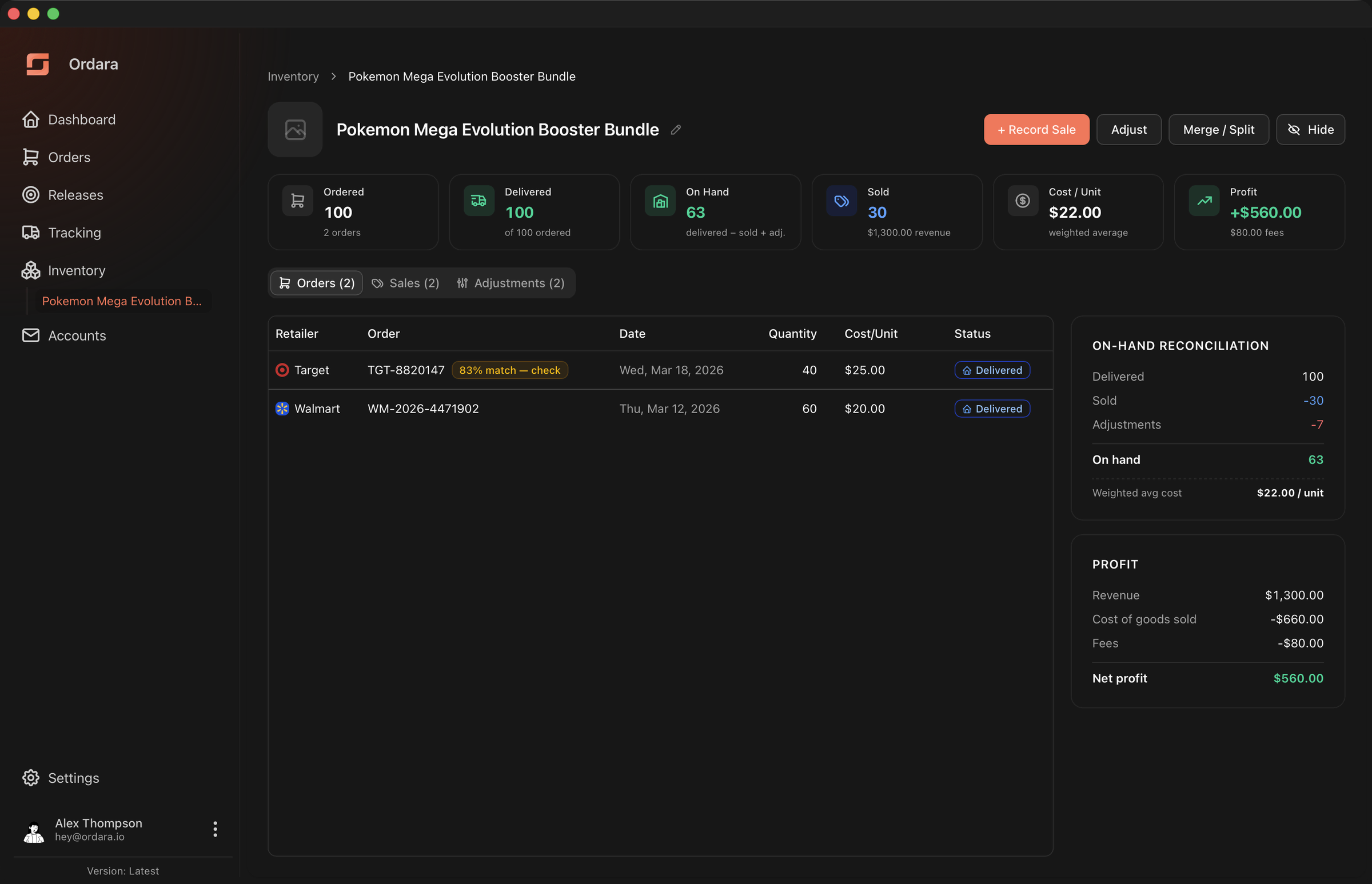
The right-hand rail on a product page shows the two equations:
On-hand reconciliation
| Line | Units |
|---|---|
| Delivered | 100 |
| Sold | −30 |
| Adjustments | −7 |
| On hand | 63 |
Profit
| Line | Amount |
|---|---|
| Revenue | $1,300.00 |
| Cost of goods sold | −$660.00 |
| Fees | −$80.00 |
| Net profit | $560.00 |
A worked example, end to end
One product, bought twice, sold twice, with two damaged units and one count correction.
Purchases
| Order | Units | Price / unit | Line cost |
|---|---|---|---|
| Walmart | 60 | $20.00 | $1,200.00 |
| Target | 40 | $25.00 | $1,000.00 |
| Total | 100 | $22.00 weighted avg | $2,200.00 |
Sales
| Date | Channel | Units | Price / unit | Revenue | Fee |
|---|---|---|---|---|---|
| Apr 10 | eBay | 20 | $40.00 | $800.00 | $80.00 |
| May 5 | TCGplayer | 10 | $50.00 | $500.00 | — |
| Total | 30 | $1,300.00 | $80.00 |
Adjustments
| Date | Change | Reason |
|---|---|---|
| May 20 | −2 | Damaged |
| May 21 | −5 | Count correction |
The resulting figures
| Metric | Value | How |
|---|---|---|
| Ordered | 100 | |
| Delivered | 100 | |
| Sold | 30 | |
| Adjustments | −7 | −2 damaged, −5 count correction |
| On hand | 63 | 100 − 30 − 7 |
| Unsold | 70 | 100 − 30 |
| Cost/Unit | $22.00 | $2,200 ÷ 100 |
| Revenue | $1,300.00 | |
| COGS | $660.00 | 30 sold × $22.00 |
| Fees | $80.00 | |
| Profit | $560.00 | $1,300 − $660 − $80 |
The same period as a Profit & Loss statement, which also charges the damaged units as an expense and ignores the count correction:
| Line | Amount | Margin |
|---|---|---|
| Revenue | $1,300.00 | |
| Cost of goods sold | −$660.00 | |
| Gross profit | $640.00 | 49.2% |
| Selling fees | −$80.00 | |
| Shrinkage / write-offs | −$44.00 | |
| Net profit | $516.00 | 39.7% |
Shrinkage is inventory you lost rather than sold. Ordara values it at cost (2 × $22.00) and charges it in the period you recorded the adjustment. The 5 corrected units are not an expense: a count correction means your records were wrong, not that you lost anything. See Profit & Loss Reports.
Three profit figures, two formulas
The product page's Profit ($560.00) leaves write-offs out. The portfolio Profit / Loss card ($516.00) and the statement's Net profit ($516.00) both charge them, so the card matches a statement covering all of your history (unless you have hidden products; see Hiding a product).
Where to go next
- Profit & Loss Reports: the income statement for a period
- Accuracy & Limitations: every approximation in these figures, and what it means